

About ArcSpan
33 years inside the environments where this work matters most.
Bruce R. Arcurio, Ed.D. founded ArcSpan after 33 years as a public school educator and leader in New Jersey. He has sat in the superintendent's chair during board conflict. He has navigated governance breakdown, leadership transitions, and organizational strain from the inside -- under public scrutiny, with real stakes, and without the option of simply stepping away.
That experience is the foundation of ArcSpan's work. School governance conflict is not like workplace conflict or civil disputes. The relationships are public and long-term. The stakes are visible to the community. The cost of mishandling a board-superintendent breakdown falls on students, staff, and administrators who had nothing to do with creating it. A mediator who has never sat in those rooms is working without the context that makes the difference.
Bruce is a trained civil mediator through the New Jersey Association of Professional Mediators (NJAPM). Mediation training gave structure and discipline to what his leadership career gave him in instinct and context. The combination shapes how he prepares participants, holds the room, and keeps conversations productive when emotions are high and positions have hardened.
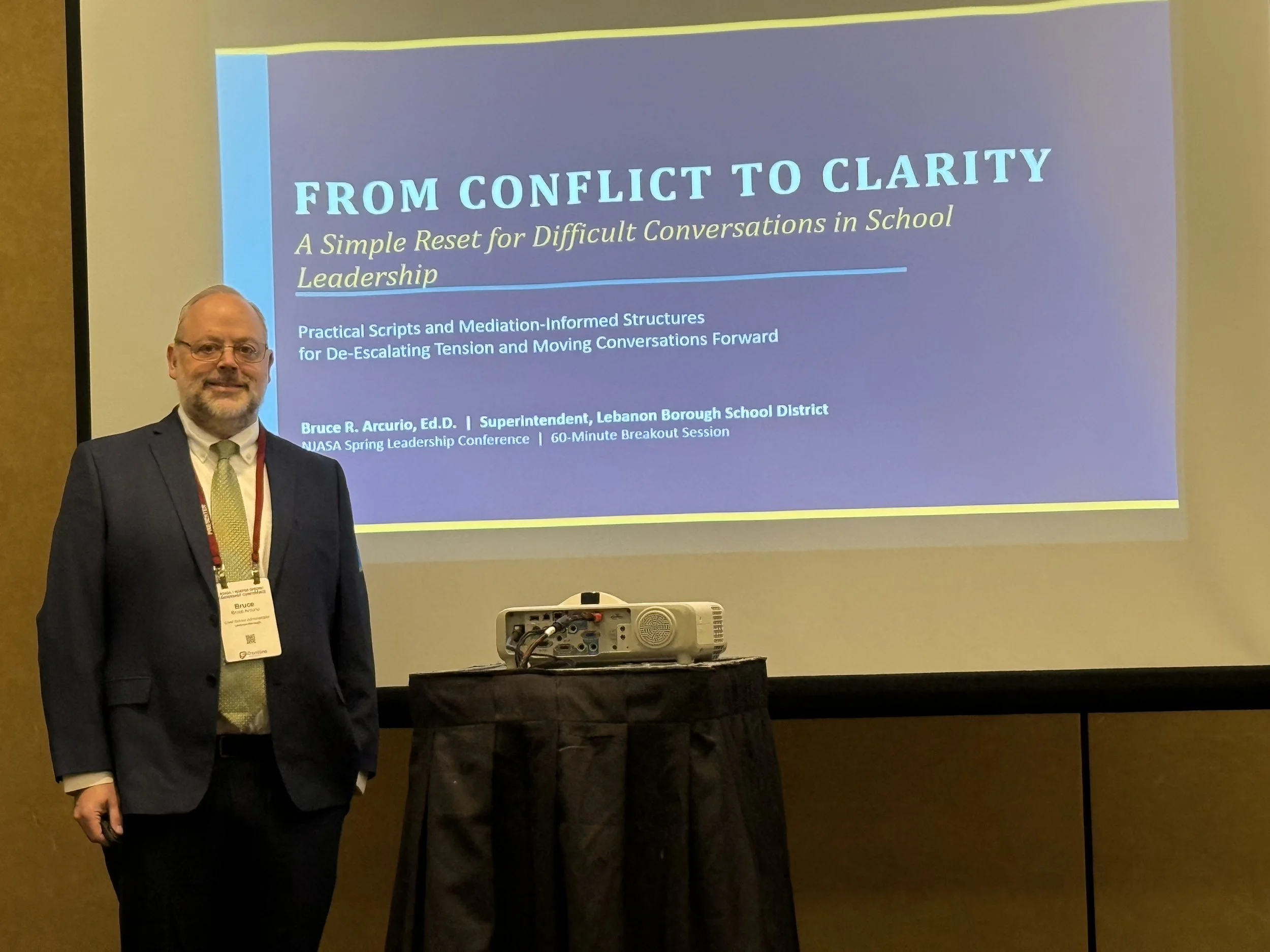
Bruce R. Arcurio, Ed.D. -- NJASA Spring Leadership Conference, 2026
Why the name.
ArcSpan is named deliberately. In conflict, people are often standing on opposite sides of an issue with no clear way across. The mediator's or facilitator’s role is not to pull anyone to one side or impose a resolution. It is to build the structure that allows movement: understanding on both sides, productive dialogue, and agreement when direct conversation alone has stopped working.
How the work gets done.
ArcSpan's engagements are structured, phased, and focused on clear outcomes. Every engagement begins with individual, confidential conversations — not a joint session where positions immediately harden. The diagnostic phase informs everything that follows: the design of the facilitated session, the topics that need direct attention, and the understandings that will actually hold after the engagement ends.
Neutrality, confidentiality, and respect for the process are not principles Bruce recites. They are operational commitments that show up in how every session is prepared and conducted.
If you are in the middle of something difficult right now.
If your board relationship has deteriorated to the point where governance is impaired -- if your leadership team is consuming its energy on internal conflict rather than the work -- if staff conflict has reached the point where internal processes are no longer holding -- if you are not sure whether what you are experiencing rises to the level of needing outside help -- the first step is a confidential conversation.
ArcSpan's work extends across board-superintendent conflict, staff and workplace mediation, post-exit stabilization, and professional development for leadership teams. If the situation involves conflict in an educational or organizational setting, it is worth a conversation.
That conversation is free, it takes 30 to 45 minutes, and it ends with either a clear proposal or an honest assessment that a different approach would serve you better.